Filter on, then off
A camera, phone or lens needs a proper solar filter on the front for every partial phase. Only during totality does the filter come off, to capture the corona.
August 2, 2027 · Luxor, Egypt
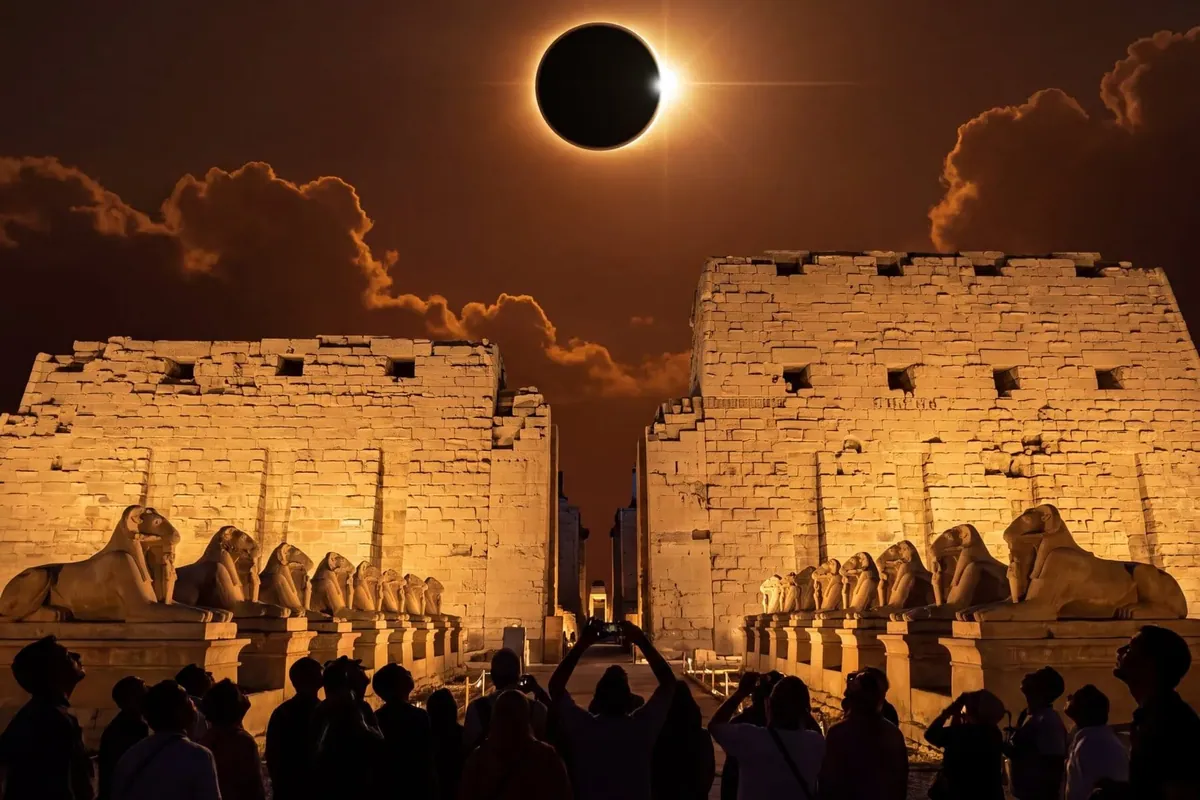
For more than six minutes on August 2, 2027, day turns to twilight over Luxor. Here is what you will see, when, and how to watch every phase safely.
In the sky
A small dark notch appears on the edge of the sun. From now on, look only through certified glasses.
In the last minutes before totality the light turns silvery and strange, and shadows grow sharp.
The last bead of sunlight disappears. The sky darkens to a deep twilight in the middle of the day, the air cools by a few degrees, and the horizon glows with sunset colours all around you.
The pearly corona of the sun appears around the black disc of the moon. Bright planets come out: Venus close beside the sun, Jupiter further along the sky, and probably Mercury.
The first bright point of sunlight returns, and the glasses go straight back on.
The moon leaves the face of the sun, and the eclipse is over.
The science
A total solar eclipse happens when the moon passes directly between the Earth and the sun and covers the solar disc completely along a narrow corridor on the Earth's surface. Outside that corridor, people see only a partial eclipse. Inside it, day becomes night.
On August 2, 2027 that corridor crosses Upper Egypt, and Luxor lies almost exactly on its centre line, with about 6 minutes 20 seconds of totality and the sun almost directly overhead.
Watching safely
Keep certified glasses on through the whole partial phase, from about 11:40 until the sun is completely covered. When the last bead of sunlight disappears it is safe to take them off and see the corona with your own eyes. As soon as the first bright point of sunlight returns, at about 13:08, they go straight back on.
Ordinary sunglasses are never safe for looking at the sun, however dark. Cameras, binoculars and telescopes need their own solar filters fitted to the front, and you should never look through unfiltered optics, even while wearing eclipse glasses.
Photographing it
A camera, phone or lens needs a proper solar filter on the front for every partial phase. Only during totality does the filter come off, to capture the corona.
With the sun almost directly overhead, bring a tripod head that can tilt to point straight up.
Practise with your camera before you travel, so the six minutes are for the sky, not the settings.
Bringing a drone into Egypt without prior government permission is against the law; drones are usually confiscated at the airport.
The sky of the pharaohs
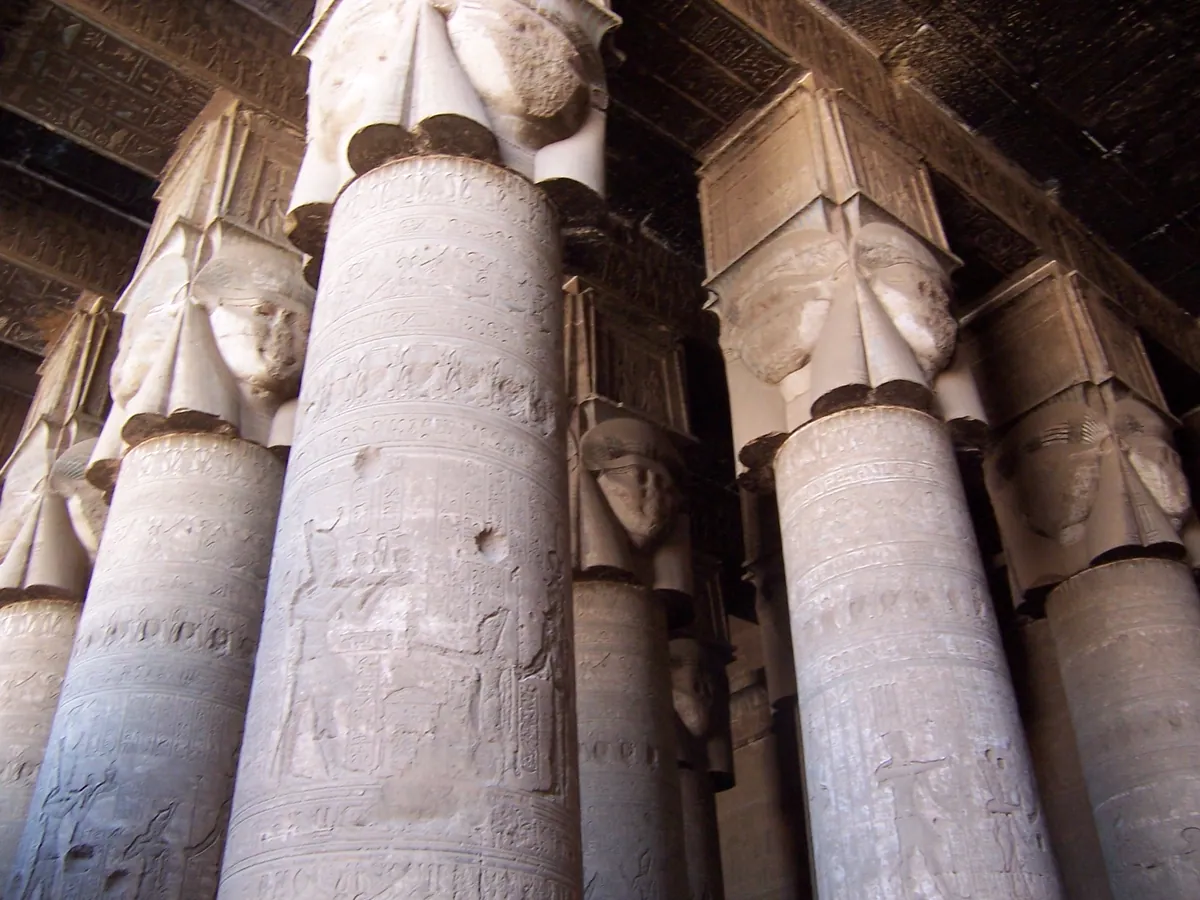
Aswan is ancient Syene, where the Greek scholar Eratosthenes used the noon sun to measure the Earth. At Dendera, the great hall of the Temple of Hathor is famous for its astronomical ceiling, cleaned in recent years to reveal its original blues and golds, with the sky goddess Nut stretched across the heavens.
Both lie on the route of our journey, in the days after the eclipse.
Our eclipse journey
Fourteen days
Rooms and prices
Every room package includes the Four Seasons in Cairo (Premier Nile Room, 54 m², unless named) and a Nile-front room in the new building of the Pyramisa Luxor for the eclipse nights. Each room is sold individually. The main page shows every room live: a package is open until its card reads Sold out.
What's included
Choose your room on our main page and pay a 40 percent deposit; 30 percent follows on January 15 and 30 percent on April 15, 2027. We cover every card fee and the currency conversion. Payment and cancellation terms
Questions
Something no photograph fully captures. In the last minutes before totality the light turns strange and silvery and shadows grow sharp. Then the sky darkens to a deep twilight in the middle of the day, the air cools by a few degrees, and the horizon glows with sunset colours all around you. Around the black disc of the moon appears the pearly corona of the sun, which can only be seen during totality. Bright planets come out too: Venus close beside the sun, Jupiter further along the sky, and probably Mercury.
Over Luxor it lasts more than six minutes, long enough to watch, to photograph, and to turn to the people beside you and share what you are seeing. Many who have seen a total eclipse call it the most moving sight of their lives.
Yes, and they are the real thing. Every guest receives a pair of certified eclipse glasses, complimentary and yours to keep, presented in its own box with a cleaning pouch and handed to you at the briefing the evening before the eclipse.
They meet the international EN ISO 12312-2 standard for looking directly at the sun and carry the CE mark. They are made by American Paper Optics, an approved supplier on the American Astronomical Society’s official eclipse-safety list, in Bartlett, Tennessee, with lenses manufactured in the USA. You are welcome to bring your own certified glasses as well, but there is nothing to buy and nothing to forget, and they make a lovely keepsake of the day.
A telescope, binoculars, cameras and a tripod are welcome as personal items for your own use, carried in your own luggage. They travel entirely at your own responsibility, and we bear no responsibility for them, including any decision by Egyptian customs and any loss, theft or damage.
If you bring a telescope or binoculars, fit a proper solar filter to the front for the partial phases, and never look through unfiltered optics, even while wearing eclipse glasses. Egyptian customs decide what may enter the country, so a short list of your equipment with serial numbers is useful in case they ask. Museums and many sites do not allow tripods, the Grand Egyptian Museum among them.
Please leave drones at home: bringing a drone into Egypt without prior government permission is against the law, and drones are usually confiscated at the airport.
Very unlikely. Upper Egypt in early August has some of the clearest skies on earth: it practically never rains in summer, and satellite records of cloud along the eclipse path put average afternoon cloud over Luxor in August close to zero. That is why eclipse travellers worldwide chose Luxor above every other place on the path. The rare spoilers are thin high cloud or dust.
A total eclipse is still a natural event and no one can command the sky, so the journey proceeds in every weather, as our cancellation terms explain. But there are few places on earth where the odds are better, and with the Pyramids, the Valley of the Kings, Abu Simbel and the Nile around it, this is a journey worth taking in its own right.
City and Sea Travel, the family-run Egyptian tour operator that owns and operates the M/S City and Sea Adonis and runs this journey. Reservations are made on our main website, cityandseaadonis.com.
Who we are
City and Sea Travel is a family-run Egyptian tour operator, founded in 2010, and the owner and operator of the M/S City and Sea Adonis. We plan every journey ourselves and run it with our own ship and our own team.
One departure · 53 rooms
July 30 to August 12, 2027. Our first eclipse journey sold out almost a year before departure.
See rooms and prices